
The AuraShop timeline
From creating the Azure account to running on Azure: every stage, every decision, in order.
Step 1 of 9: Preparation
Back to the programmePreparation
Set up the foundations so Week 1 starts building on day one.
Delivers
- Azure account and budget
- Environment design
- Infrastructure standards
- Migration plan reviewed
- GitHub repository and pipeline identity
Journal entries
Design proposal and migration strategy published
What we did
We published the environment design and the migration strategy, and added a Timeline page that shows every stage of the programme in order.
Why
So anyone can see the design before it's built, and follow each step as it happens.
What's next: Price the design in the Azure Pricing Calculator.
Azure foundations in place
What we did
We renamed the Microsoft tenant to WedgewoodAI Tapui Limited and the subscription to follow our naming standard, confirmed security defaults are on so multi-factor authentication is required, set up and tested an emergency access account, and moved the NZ$200 budget onto the subscription so it runs in New Zealand dollars.
Why
Identity, access and cost controls come before any infrastructure is built.
What's next: Review AuraShop’s design documents and price the design.
Migration plan reviewed
What we did
We reviewed the AuraShop developer's migration plan against our design. AuraShop turned out to be simpler than expected: one web app, one small database and no stored files. We kept Container Apps, kept the existing sign-in, dropped a speech service we don't need, and listed the services that stay outside Azure for now.
Why
Planning from the real application, not assumptions, keeps the four-week timeline realistic.
Evidence
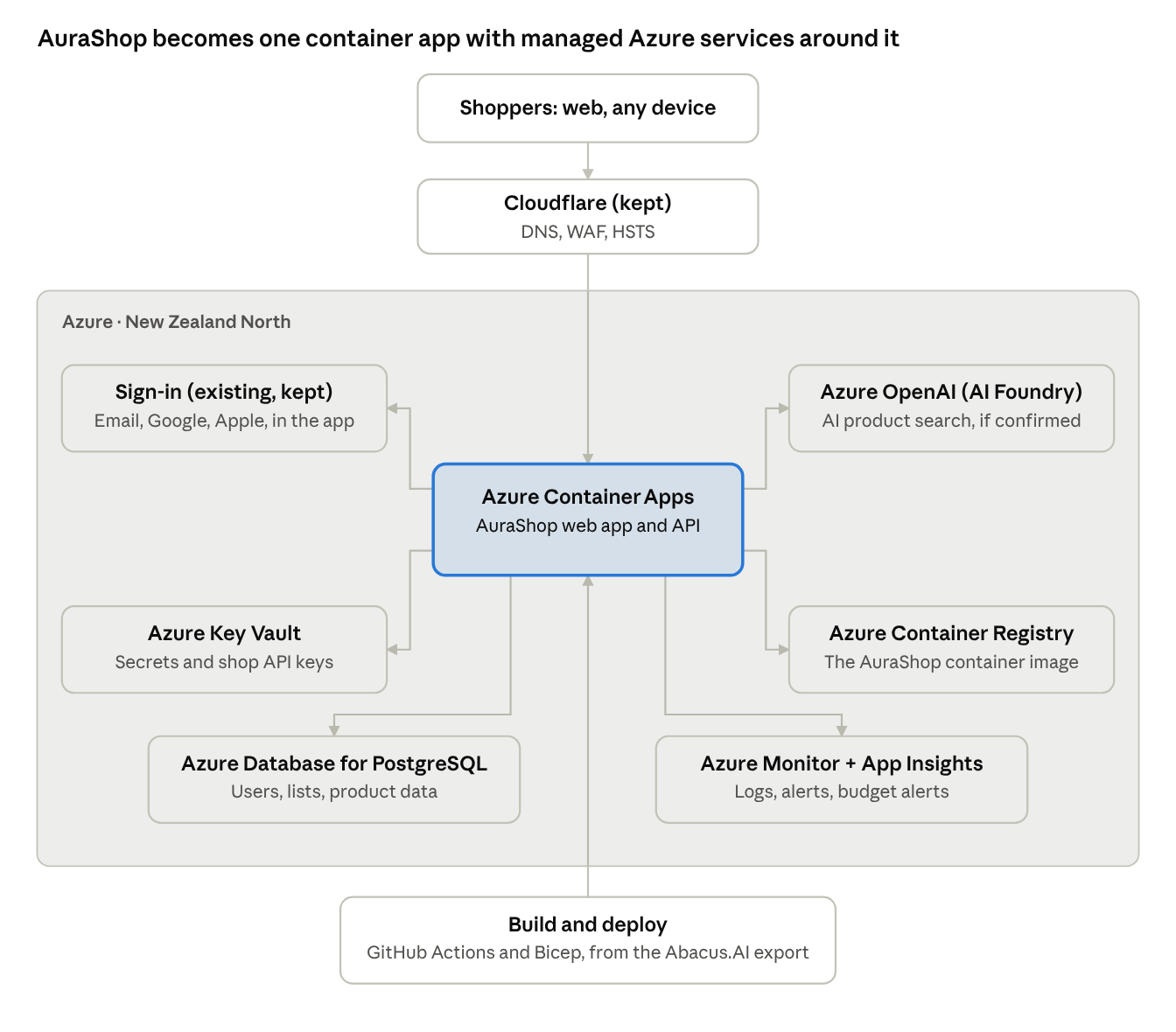
What's next: Write AuraShop's design documents, then price the design in the Azure Pricing Calculator.
Environment design drafted
What we did
We designed WedgewoodAI's Azure environment from scratch: one Microsoft Entra tenant, one management group, and two subscriptions, production and non-production. Each subscription has three resource groups: platform, app and data. We also listed everything the owner has to provide before any infrastructure code runs.
Why
Production and non-production share the same shape, so the same Bicep templates deploy both. Only production changes need the owner’s approval.
Evidence
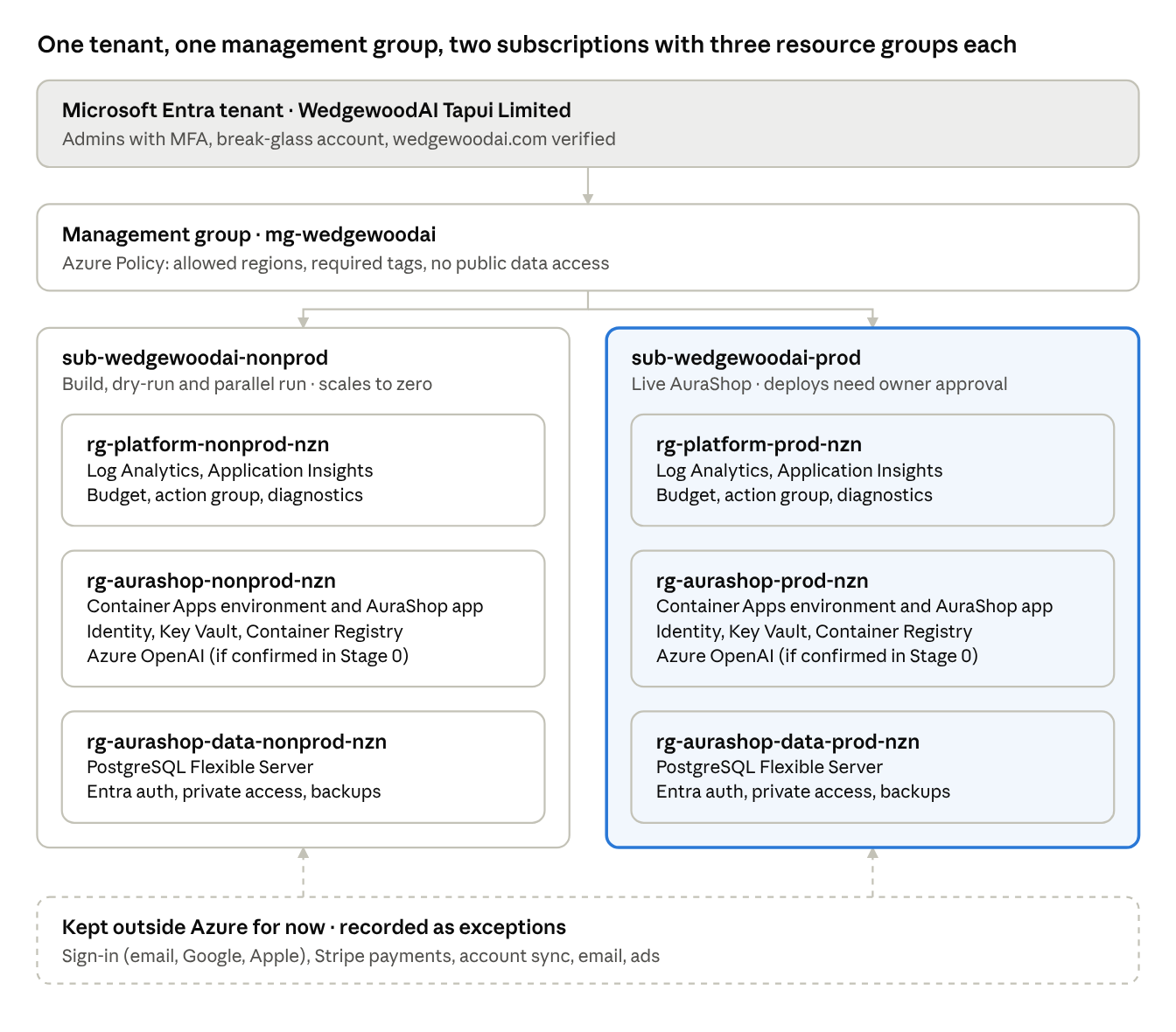
What's next: Confirm the AuraShop inventory from the migration plan, then price it in the Azure Pricing Calculator.
Budget set at $200 a month
What we did
Before deploying anything, we set a monthly budget of NZ$200 on the subscription, with email alerts at 50%, 80% and 95%.
Why
Pay-as-you-go has no spending limit. A budget doesn't stop charges, but it means we hear about them early. The last alert is at 95% rather than 100%, so there's still time to act.
What's next: Replace it with a production budget based on the cost estimate.
WedgewoodAI's Azure account is live
What we did
We created WedgewoodAI's Azure account on pay-as-you-go billing. The free trial wasn't available, because Microsoft allows one free account per person.
Why
The company’s cloud stays separate from personal accounts, the way a client environment would be set up.
What's next: Multi-factor authentication, a named administrator and an emergency break-glass account.
Four weeks, end to end
What we did
We set the migration as a four-week, AI-assisted delivery, running from 2 to 27 November 2026, with October for preparation.
Why
AI-assisted building, infrastructure as code and automated release let a small team run all eight stages in one month.
What's next: Finish the October preparation, so Week 1 starts building on day one.
Infrastructure standards written
What we did
We wrote the standards the Bicep templates and the deployment pipeline must meet: modules, naming, tagging, security, an access model with no stored passwords, and rules for keeping the code safe to publish.
Why
The templates will be published as a working example, so they have to be right, secure and readable from the start.
What's next: Review the migration plan against these standards.
Decisions made during this stage
Host in Azure New Zealand North
AuraShop and its database run in Azure New Zealand North; a few external services, such as payments, stay where they are for now. Any AI service not offered in NZ North would use Australia East, and that will be recorded here.
Run the app in Azure Container Apps
One container, no servers for a small team to patch, and scales to zero when idle.
Keep a hybrid model
Author in Abacus.AI, release to Azure through a CI/CD pipeline.
Deliver in four weeks, starting 2 November 2026
AI-assisted build, infrastructure as code and automated release let a small team run all eight stages in one month. Work starts after Labour Day, once the migration plan has been reviewed.
Keep the existing sign-in for the move
Shoppers keep signing in with email and password, Google or Apple. Changing sign-in during a four-week migration adds risk; Microsoft Entra External ID is a later stage.
Move AI product search to Azure OpenAI, if a suitable model is available in NZ North
Checked in Stage 0 against today’s search quality. If not, the current AI service stays and the reason is recorded here.
Some services stay outside Azure for now
Stripe payments, the WedgewoodAI account sync, email, sign-in providers and advertising remain external services, recorded as exceptions. AuraShop and its database run in New Zealand North.
Azure Container Apps over App Service
Both fit; Container Apps scales to zero for a small user base and runs AuraShop as a single container.
Stage 0. Decision and baseline
Measure AuraShop on Abacus.AI today and confirm the design.
Planned deliverables
- Baseline table filled inPlanned
- Cost estimate publishedPlanned
- Decisions confirmedPlanned
Stage 1. Code export and repo
Get AuraShop's code out of Abacus.AI and into a repository.
Planned deliverables
- Code exportedPlanned
- Repository structurePlanned
- First Bicep modulesPlanned
Stage 2. Azure landing zone
Build the environment with code, through the pipeline.
Planned deliverables
- Platform, app and data resource groups in non-productionPlanned
Stage 3. Data dry-run
Prove the data moves across correctly.
Planned deliverables
- Test copy of the data in PostgreSQL, checked against the baselinePlanned
Stage 4. Release pipeline
Make every release automatic, reviewed and approved.
Planned deliverables
- Deployment workflow with the production approval gatePlanned
Stage 5. Parallel run
Run Azure alongside Abacus.AI before switching.
Planned deliverables
- AuraShop running on Azure in parallel, with Abacus.AI still serving shoppersPlanned
Stage 6. Cutover
Switch shoppers to Azure, with a way back.
Planned deliverables
- DNS switched at CloudflarePlanned
- Rollback plan readyPlanned
Stage 7. Steady-state hybrid
Run, measure and report.
Planned deliverables
- Azure results compared with the baselinePlanned
- Well-Architected reviewPlanned